

Baby Massage Techniques: A Gentle Guide to Bonding and Soothing Your Little One
Imagine a quiet evening where the world finally stills, and the only sound is the soft rhythm of your breath meeting your baby’s. For many new parents, these moments are often clouded by the worry of "doing it right" or the exhaustion of trying to settle a baby struggling with wind. Perhaps you’ve heard that certain baby massage techniques can help, but you feel a little unsure of your own hands. It’s a vulnerable space to be in. We understand that deep desire to soothe your little one whilst feeling slightly disconnected from your own intuition. 🕊️
This practice is about so much more than just physical touch; it’s a beautiful, two-way conversation that builds your confidence and settles your baby’s soul. In this guide, we’ll explore how this nurturing art can help relieve the discomfort of colic, encourage deeper sleep, and create a daily ritual of pure connection. You’ll discover how to read your baby’s subtle cues with ease, transforming those anxious moments into a steady flow of love and reassurance. Let’s begin this journey of touch together. ✨
Key Takeaways
Understand how intentional touch releases oxytocin, the "love hormone", to soothe stress for both you and your little one.
Learn how to create a calming environment and identify the "quiet alert" state, ensuring your baby is perfectly primed for connection.
Master foundational baby massage techniques like "Resting Hands" and "Indian Milking" to support your baby's circulation and growth.
Gain the confidence to read your baby’s subtle physical cues, allowing you to respond with empathy to their unique needs and boundaries.
Discover the power of the "village" and how learning massage in a supportive group can help ease the isolation of early motherhood.
Table of Contents
The Heart of Baby Massage: Why These Techniques Matter
Touch is our first language. Long before your baby understands the whispered words of "I love you," they feel that devotion through the warmth and weight of your hands. Baby massage techniques are far more than a simple sequence of physical strokes; they are a rhythmic, intentional way of communicating safety, belonging, and deep affection. It is a beautiful, wordless conversation that allows you to meet your baby exactly where they are. In the quiet of a massage session, you aren't just "doing" a task. You are simply "being" with your child. This transition from the frantic "doing" of early motherhood to the grounded "being" is a vital part of your own postnatal journey. It allows you to reclaim your sense of self whilst deepening the bond with your little one. 🌿
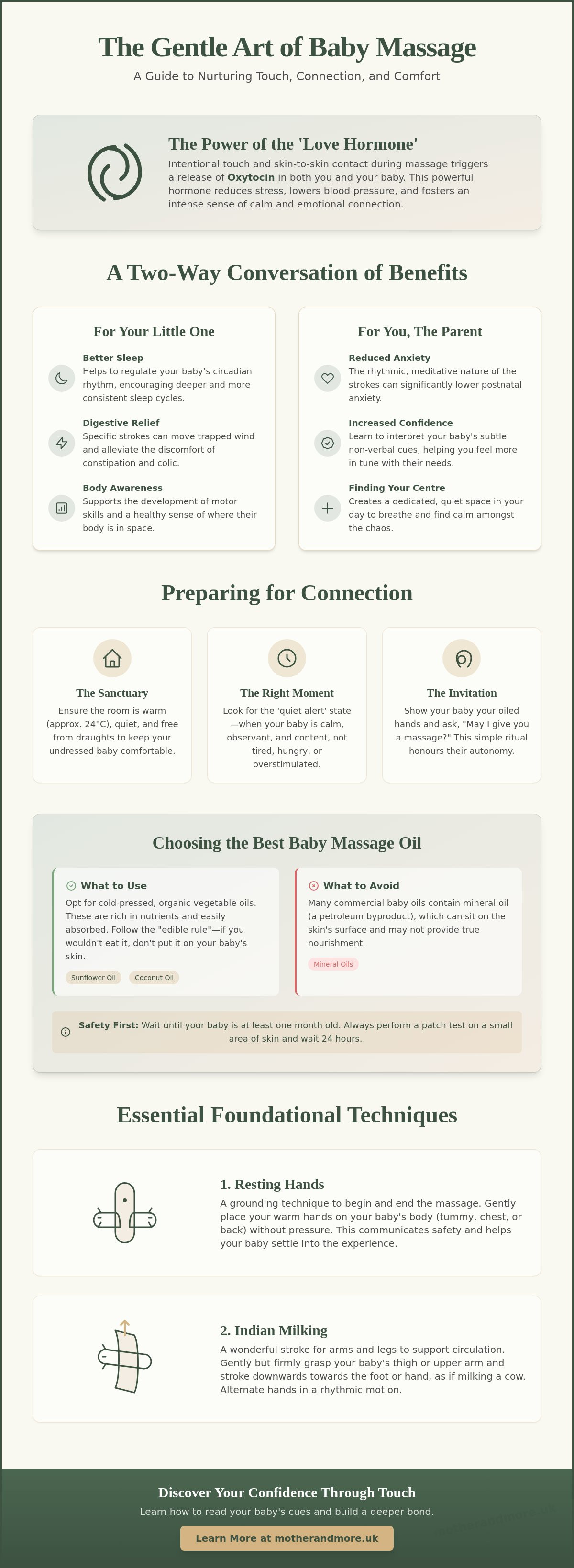
This ancient art has been practiced across global cultures for centuries to support infant health. Exploring the history of infant massage reveals a deep-rooted understanding of how touch nourishes a child's development from the very beginning. When you engage in skin-to-skin contact, it triggers a powerful "love cocktail" of oxytocin in both you and your baby. This hormone reduces stress, lowers blood pressure, and fosters a sense of intense emotional connection. Baby massage is a holistic practice that supports physical growth and emotional security.
Physical and Emotional Benefits for Your Little One
For your baby, the benefits of regular massage are profound and far-reaching. It isn't just about relaxation; it’s about supporting their rapidly developing systems. Consider these key advantages:
Better Sleep: Evening massage helps regulate your baby’s circadian rhythm, encouraging more consistent sleep cycles.
Digestive Relief: Specific strokes can support the digestive system, helping to move trapped wind and alleviate the discomfort of constipation or colic.
Body Awareness: Gentle manipulation of the limbs helps your baby develop motor skills and a healthy sense of where their body is in space.
The Reassuring Embrace: Benefits for You
We often focus on the baby, but this ritual is equally transformative for you as a mother. It provides a much-needed anchor in those early, often overwhelming weeks. 🌸
Reduced Anxiety: Focusing on the rhythmic, meditative nature of the strokes can significantly lower postnatal anxiety levels.
Increased Confidence: As you learn to interpret subtle non-verbal cues, you'll feel much more capable and "in tune" with your baby’s needs.
Finding Your Centre: Massage creates a dedicated, "unplugged" space in your day to breathe and find a moment of calm amongst the chaos of new parenthood.
Preparing for Connection: Environment and Baby Massage Oil
Setting the scene for your baby massage techniques is just as important as the strokes themselves. Think of it as creating a sensory sanctuary where your little one feels entirely safe and seen. To keep your baby comfortable whilst they are undressed, ensure the room is warm and draught-free; a temperature of about 24 degrees is usually ideal. Timing is everything. You're looking for that "quiet alert" state, which is when your baby is calm and observant, rather than hungry, tired, or overstimulated. 🕯️
Before you begin, try the "Asking Permission" ritual. Rub a little oil between your palms near your baby’s ears so they hear the rhythmic sound, then show them your open hands and ask, "May I give you a massage?" It’s a beautiful way to honour their autonomy from day one. Understanding how to massage your baby begins with this respectful pause, ensuring the experience is a collaborative joy rather than something done to them.
Choosing the Best Baby Massage Oil
When it comes to your baby’s skin, we follow the "edible rule": if you wouldn't feel comfortable eating it, it probably doesn't belong on their delicate, permeable skin. To help you maintain your baby’s skin health and comfort, you can learn more about Mama Bamboo and their expert advice on avoiding nappy rash. Whilst many commercial brands promote mineral oils, these often sit on the surface without providing true nourishment. Instead, many parents prefer cold-pressed, organic vegetable oils like sunflower or coconut oil. These are rich in nutrients and more easily absorbed by the skin barrier.
Safety is always our priority. Most experts recommend waiting until your baby is at least one month old before introducing oils to allow their natural skin barrier to develop. Always perform a patch test on a small area of their leg and wait 24 hours to ensure no sensitivity or allergic reactions occur. If you're looking for more guided support on choosing the right tools and oils, our Online Course offers a gentle way to learn these rituals at your own pace. 🌿
Creating Your Sanctuary at Home
Preparation prevents the flow from being broken. Keep everything you need within arm's reach: clean nappies, a soft towel, and a fresh change of clothes. Your comfort matters just as much as theirs. Sit on a soft rug or use cushions to support your back and hips; if you are physically strained, your baby will sense that tension in your touch.
Maintain soft eye contact and use a gentle hum or a favourite song to anchor the experience. This isn't just about the physical baby massage techniques; it's about the deep, sensory immersion of being fully present. Your voice and your gaze are the threads that weave this connection together. ✨
Essential Baby Massage Techniques for Every Day
Once you have settled into your warm, quiet space and completed your "Asking Permission" ritual, it is time to let your hands begin their work. We always start with "Resting Hands." This is a non-moving touch where you simply place your palms gently on your baby’s chest or tummy. It is a moment of stillness. It grounds you both, letting your baby feel the weight and warmth of your presence before the first stroke begins. Breathe together. This simple act of being still is the foundation for all baby massage techniques. ✨
From here, we move to the legs, which are often the most receptive part of a baby's body. "Indian Milking" involves a gentle, rhythmic stroke from the thigh down to the ankle, followed by "Squeezing," a soft, twisting motion that feels like a reassuring hug for the muscles. These strokes stimulate circulation and support healthy growth, providing a sensory map of their own little limbs. On the chest, try the "Open Book" stroke. Starting at the centre of the chest, flatten your hands and move them outwards to the shoulders, as if you are smoothing the pages of a favourite story. This encourages deep, rhythmic breathing and creates a sense of emotional openness.
To finish the main sequence, gently turn your baby onto their tummy for back strokes. Using long, slow movements from the neck down to the bottom, you help soothe their nervous system. These downward strokes are a powerful signal to the body that it is safe to rest and let go of the day's overstimulation. 🌿
Soothing the Tummy: Techniques for Colic and Wind
For babies struggling with digestive discomfort, the tummy sequence can be life-changing. The "Waterwheel" technique uses the flat of your palms to move in alternating, downward strokes, gently helping air move through the digestive tract. Follow this with the "I Love U" sequence: a stroke down the baby’s left side (an "I"), an inverted "L" from the right side across and down, and an inverted "U" starting from the bottom right, moving up, across, and down the left. Finish by gently bringing their knees to their tummy and "bicycling" the legs. This physical movement is often the final key to releasing trapped wind and easing a colicky cry.
Facial and Head Massage for Relaxation
The face holds a surprising amount of tension, especially for babies who are teething or exploring solid foods. Use your thumbs to make very gentle strokes across the forehead, moving from the centre outwards. This can be incredibly soothing after a long bout of crying. Small, soft circles around the jawline can release the tight muscles used for sucking and chewing. Finally, the "Butterfly" stroke involves light, sweeping motions across the cheeks and over the bridge of the nose. It encourages a soft, relaxed expression, helping your baby drift into a more peaceful state of being. 🌸
Understanding Your Baby’s Cues: When to Stop or Adjust
Learning the physical baby massage techniques is only half of the journey. The other half, perhaps the most profound part, is learning to listen to the silent language your baby speaks through their body. This isn't a performance; it’s a partnership. You are looking for a "Yes" from your little one. These cues are often soft and subtle: steady eye contact, relaxed, heavy limbs, or sweet, rhythmic cooing. When you see these, you know your baby is open and ready to receive your touch. ✨
Conversely, it is just as vital to recognise the "No" or "Stop" cues. Your baby might turn their head away, arch their back, or suddenly stiffen their body. They might start to fuss or even cry. These aren't signs of failure on your part. They are simply your baby’s way of saying, "I’ve had enough for now." We must always honour these boundaries. Forcing a massage can create tension and break the trust you are trying to build; it must always be an invited experience. If you find yourself feeling anxious, wondering "Am I doing this right?", take a deep breath. In our work with mums, we often see this pressure to be perfect. If you need a little extra support to find your footing, joining one of our Baby Massage Courses can provide a safe space to learn these cues alongside other parents.
Dealing with Overstimulation
Sometimes, the world is just too loud. Overstimulation happens when the sensory input exceeds your baby’s current capacity to process it. You might notice them hiccuping, sneezing, or looking away repeatedly. In these moments, less is truly more. Mastering these baby massage techniques is a journey of patience; start with just 5 minutes of touch and gradually build up as your baby gets older and their nervous system matures. If they become fussy, gently transition out of the massage by wrapping them in a warm towel and offering a quiet cuddle. There is no rush. 🕊️
The Non-Judgmental Approach
There will be days when the massage just doesn't happen. Life with a newborn is unpredictable, and that is perfectly okay. Perhaps you’re too tired, or your baby is simply out of sorts. Focus on the quality of your connection rather than ticking off every single stroke in a sequence. Your "good enough" is exactly what your baby needs; they don't need a perfect therapist, they just need their mum. Embrace the flow of your day and know that the opportunity for connection will always be there tomorrow. 🌸
Beyond the Strokes: Integrating Massage into Your New Identity
As you grow more comfortable with the physical baby massage techniques, you may notice a subtle shift within yourself. This ritual begins to transcend the simple act of soothing a baby. It becomes a cornerstone of your own postnatal recovery. In those early months, it’s easy to lose sight of your own needs amongst the endless cycle of feeds and nappies. Massage offers you a way back to yourself. It is a moment of grounding. It is a practice of self-care that requires no equipment; it only asks for your presence and your breath. 🕊️
Early motherhood can feel surprisingly isolating, even in the heart of a bustling city. There is a profound power in finding your "village." Whilst practicing at home is beautiful, there is a different kind of magic that happens when you learn in the company of others who truly understand the sleep-deprived haze you are navigating. Sharing these moments helps alleviate the heavy silence of those first few weeks, reminding you that you aren't walking this path alone.
Finding Your Village in East London
If you are looking for a space to connect, our baby massage classes in East London offer a true sanctuary. These aren't just instructional workshops; they are gentle gatherings designed to nourish both mum and baby. You’ll find yourself amongst a local network of parents, building support systems that often last long after the final session. Unlike learning from a screen, an in-person workshop allows for real-time adjustment and the warmth of human connection. It’s a place where you can be yourself, messy and tired and wonderful all at once. ✨
A Message to the Mother
Your journey into motherhood is a massive transformation. It is a shift in identity that deserves to be honoured. My background in life coaching informs every stroke we teach. We focus on presence, confidence, and the power of the "now." When you are fully present with your baby, you are also practicing being present with yourself. This confidence ripples out into every other area of your life. You begin to trust your own maternal intuition over the noise of external advice. 🌸
Take these baby massage techniques and make them your own. Use them as a tool for grounding when the day feels chaotic. Above all, trust the wisdom of your own hands and the depth of the love you feel. You are exactly the mother your baby needs. You are doing a beautiful job. 🌿
Trust Your Hands and Your Heart
You’ve explored how baby massage techniques are so much more than a physical routine; they are a rhythmic dance of love and presence. By creating a warm sanctuary, choosing the right oils, and honouring your baby’s cues, you’ve already taken the first steps toward a calmer, more settled home. Remember that this journey is as much about your own grounding as it is about soothing your little one’s tummy or helping them drift into sleep. 🕊️
Whilst practising at home is a beautiful start, there is something truly transformative about learning within a supportive village. Led by accredited life coach and baby expert Rebecca Beazley, Mother And More has supported over 2,000 local families in our five-star nurturing environment in the heart of East London. We invite you to step out of the isolation of early motherhood and into a space where you can truly breathe.
Book your place at our next Baby Massage Course in East London and discover the confidence that comes from being fully seen and supported. You are doing a wonderful job, and your intuition is your greatest guide. ✨
Frequently Asked Questions
When is the best time of day to massage my baby?
The ideal time for massage is when your baby is in a "quiet alert" state, typically after a nap or between feeds. It is best to wait at least 45 minutes after a feed to allow their tummy to settle. Many parents find that a gentle session after a bath but before bed helps create a rhythmic transition into sleep, though you should always follow your baby's individual energy levels. 🌙
Can I massage my baby if they have a cold or fever?
You should avoid a full massage if your baby has a fever or seems particularly unwell. When a baby is fighting an infection, their body needs to focus all its energy on recovery rather than processing the sensory input of a massage. If they have a very mild cold without a temperature, you might find that simple "Resting Hands" on the chest provides comfort without being too stimulating for their system.
How soon after birth can I start using these massage techniques?
You can begin using very gentle, non-oil touch like "Resting Hands" from birth, but it is usually best to wait until four to six weeks for a full routine. This allows your baby’s umbilical cord to heal completely and their natural skin barrier to strengthen. Starting baby massage techniques at this stage ensures their skin is ready for oils and their nervous system can better handle the focused interaction. 🕊️
What should I do if my baby starts crying during the massage?
Stop the massage immediately and offer a soothing cuddle, a feed, or a nappy change. Crying is your baby’s way of communicating that they have reached their limit or aren't in the right frame of mind for touch. Honouring this boundary is essential for building a foundation of trust. You can always try again tomorrow; there is never any pressure to complete a full sequence if your baby isn't enjoying it.
Is it safe to use olive oil or mustard oil for baby massage?
Current guidance suggests avoiding olive and mustard oils as they can potentially damage the skin’s delicate barrier or cause irritation. Instead, we recommend using edible, cold-pressed vegetable oils such as sunflower or coconut oil. These are much gentler on permeable skin and are less likely to cause a reaction whilst you are practising your baby massage techniques. Always remember to perform a patch test first. 🌿
How long should a typical baby massage session last?
A typical session can last anywhere from five to twenty minutes, depending on your baby's age and receptivity. Newborns may only have the capacity for five minutes of touch before they become overstimulated. As they grow and become familiar with the ritual, the sessions will naturally lengthen. Focus on the quality of your connection and your baby’s cues rather than watching the clock; a short, happy session is always better than a long, fussy one.
Do I need to take a professional course to learn these techniques?
While you can learn basic strokes at home, a professional course offers a supportive environment to build your confidence and intuition. Our classes provide expert guidance from Rebecca Beazley, helping you refine your touch whilst connecting with a local community of parents. This "village" atmosphere is often exactly what a new mother needs to feel less isolated and more empowered in her new role. ✨
Can fathers or other caregivers use these massage techniques too?
Absolutely, massage is a brilliant way for dads and other caregivers to develop their own deep, emotional bond with the baby. It provides a practical, hands-on way to soothe and connect, which is especially valuable for those who might not be the primary caregiver. We even offer dedicated workshops for dads to help them feel confident and present, ensuring the whole family can share in this beautiful ritual. 🌸


Comments