

Career Coaching for New Mums in London
Becoming a mum hasn’t erased your professional skills; it may simply be harder to see them right now. To identify what you can bring to a new role, list tasks you’ve handled at work and in everyday life, then name the skills behind them, such as planning, communication, problem-solving and adapting under pressure. Career coaching for new mums in London can help you connect those strengths with realistic career options.
It’s understandable if your confidence feels different after maternity leave or a career break. Your priorities may have shifted, and the work you once pictured yourself doing may no longer fit family life in the same way. That doesn’t mean you have to start from scratch.
This guide will help you recognise transferable skills, rebuild confidence in your professional identity and compare coaching formats, programme durations and payment options. You’ll also find practical ways to weigh up individual and group support, so you can choose what feels manageable alongside your time, responsibilities and next career step.
Table of Contents
How do I figure out my transferable skills for a career change?
Start with evidence, not job titles. Write down tasks from your previous role and your parental responsibilities, then identify the skills each task required. Organising a project may show planning; coordinating nursery pick-ups alongside deadlines may demonstrate prioritisation and communication.
Returning after maternity leave can change what you need from work. Before searching for roles, note what you want to keep, change or leave behind. For example, you might enjoy solving clients’ problems but want fewer late meetings. That distinction turns a broad wish for change into criteria you can use to compare roles.
Try this three-step skills exercise:
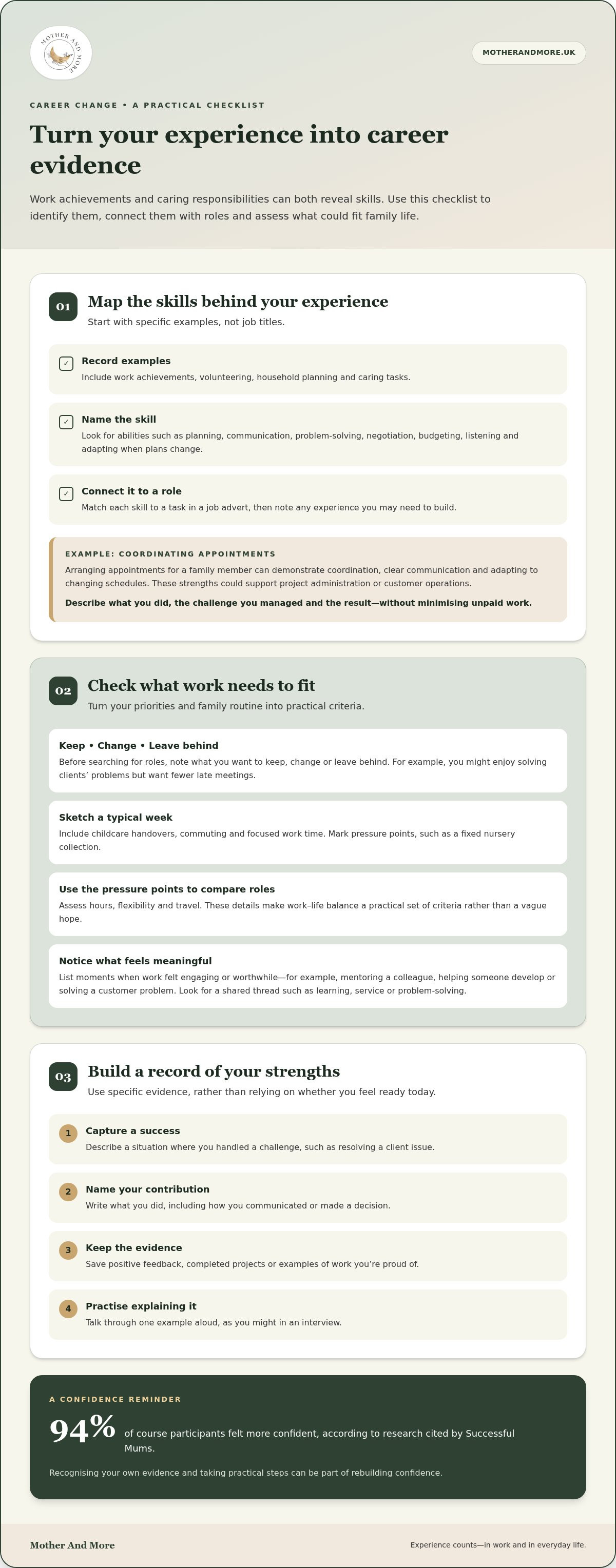
Record examples: include work achievements, volunteering, household planning and caring tasks.
Name the skill: link each example to abilities such as negotiation, budgeting, listening or adapting when plans change.
Connect it to a role: match each skill to a task in a job advert, then note any experience you may need to build.
For instance, arranging appointments for a family member involves coordination, clear communication and adapting to changing schedules. At work, those strengths could support project administration or customer operations. The example is useful when you can explain what you did, the challenge you managed and the result, without minimising unpaid work.
Family routines also shape what kind of career feels sustainable. Sketch a typical week, including childcare handovers, commuting and focused work time. Mark pressure points, such as a fixed nursery collection, then use them to assess hours, flexibility and travel. This turns work-life balance into practical criteria rather than a vague hope.
Career fulfilment deserves the same attention as logistics. List the moments when work felt engaging, such as mentoring a colleague or solving a customer problem. Compare those moments with your current priorities. Research cited by Successful Mums found that 94 per cent of course participants felt more confident, a reminder that confidence can be part of the return-to-work process.
When choosing a coach to support your return after maternity leave, look for experience with career direction, parental transitions and practical return-to-work planning. The approach should help you translate real examples into skills, options and manageable next steps.
London coaches focus on different parts of this transition, including helping professional women balance family life with a fulfilling career. Look for support that matches your needs, whether you’re returning to your field, changing direction or reshaping how work fits around family.
Career confidence and professional identity
Confidence can feel unsettled when motherhood changes your daily rhythm and future priorities. A difficult return to work after her first maternity leave in 2017 prompted one coach to change careers. That experience illustrates how a transition can reshape what professional identity means, rather than erase what came before.
Separate your identity from your job title by noting what you value in work itself. For example, you may value creativity, financial stability, making a difference or time with colleagues. Choose the values that matter most now, then use them to assess possible roles. A role that looks impressive on paper may feel wrong if it conflicts with your priorities.
Build a confidence record with specific evidence, rather than relying on whether you feel ready today:
Capture a success: describe a situation where you handled a challenge, such as resolving a client issue.
Name your contribution: write what you did, including how you communicated or made a decision.
Keep the evidence: save positive feedback, completed projects or examples of work you’re proud of.
Use it in conversation: practise explaining one example aloud, as you might in an interview.
This record gives you something tangible to return to when self-doubt tells you that your skills have disappeared. Research cited by Successful Mums found that 94 per cent of course participants felt more confident. Confidence can grow through recognising your own evidence and taking practical steps towards work that fits.
A career change can also raise questions about belonging. If you move from finance into community work, for instance, your professional identity may shift from specialist to relationship-builder. You don’t need to choose a permanent label straight away. Try describing the qualities you want your next chapter to express, then compare that description with real roles and responsibilities.
To clarify what feels meaningful, write down three moments when work felt worthwhile. One might be helping a colleague develop; another, making a complicated process easier. Look for the shared thread, such as learning, service or problem-solving. Then consider whether it could guide a new direction, without assuming you must leave your previous experience behind.
If supporting parents and babies feels aligned with your values, baby massage instructor training may be one route to explore. It offers a practical way to consider work connected with early parenthood, while reflecting on what kind of professional role feels right for you.
Coaching formats, including individual and group programmes
The right coaching format depends on the transition you’re facing and how you prefer to reflect. One-to-one coaching gives you space to explore a personal situation, such as returning to a role after leave or seeking a promotion. Group coaching offers shared discussion, where other parents’ experiences can prompt fresh insights.
Some structured return-to-work programmes use six sessions over three to six months. Sessions usually last 60 to 90 minutes, and weekly meetings are also possible. A longer interval may leave more time to try an agreed action, such as discussing flexible hours with your manager. A closer rhythm can help you keep momentum during a busy transition.
Think about the support you need between sessions. Individual coaching may suit a sensitive workplace decision or a career plan that needs close attention. A group may work well if you value hearing how others approach similar challenges. In either format, useful coaching connects reflection with practical steps you can act on.
Career progression deserves attention alongside family responsibilities. Helen Mason supports professional women who want to avoid the ‘mummy track’ and maintain a fulfilling career and family life. Use that goal to identify what progression means to you: leading a project, developing expertise, taking on more responsibility or protecting time outside work. Your answer can shape the questions you bring to coaching.
Programme costs and payment arrangements vary by format, number of sessions and level of support. Compare the total commitment, not just the cost of one meeting. Ask whether payment is per session or for the whole programme, whether it can be split and what happens if a session needs rescheduling. These details help you understand the financial commitment before you start.
Before booking, ask a career coach:
What experience do you have with maternity leave, parental transitions and career progression?
How will sessions turn my goals into practical actions?
What does the programme include, how long does it run, and what payment arrangements are available?
These questions can help you judge whether a coach’s approach fits your needs, schedule and budget. Notice whether the first conversation gives you greater clarity about the process, rather than leaving you feeling pressured to commit. A good fit makes room for your priorities, including the belief that career growth and family life both matter.
To prepare, write down one career decision, one practical constraint and one outcome you’d like from coaching. For example, you may want to explore promotion while keeping a particular school-run routine. Bringing those points to a first session makes it easier to assess whether the programme addresses your real-life priorities.
Career coaching for mothers and working parents
Coaching can help you navigate a return to work, explore career changes and prepare for workplace conversations. For example, you could develop a flexible-working proposal or practise explaining your contribution in a pay discussion.
Career coaching services for new mums
Coaching for new mums can cover return-to-work planning, career direction and confidence in professional conversations. A structured return-to-work programme can help you plan your transition back to work. It can focus on clarifying what you want from work, identifying barriers and choosing practical actions that fit your parental responsibilities.
Some programmes also support fathers taking a career break to care for their child. This wider focus can help parents discuss how caring responsibilities affect household routines and career decisions. Before starting, write down the decision you want help with, such as returning to your previous role or exploring a different field. This gives sessions a clear starting point.
Flexible working and career changes
Use coaching to prepare for a flexible-working conversation by focusing on specific tasks and outcomes. For example, set out which responsibilities require collaboration, which can be done independently and how you would stay connected to colleagues. This turns a general request for flexibility into a practical proposal based on your role and family routine.
For a career change, compare roles by duties, values and working patterns, not just job title. Return-to-work coaching is recommended to start two months before returning, with sessions every two or three weeks. This timing leaves space to reflect between meetings and test actions. A Bloom People case study describes a new mother who temporarily reduced her working week to four days after returning full-time.
Coaching can help you navigate this kind of transition by clarifying which trade-offs feel workable. For instance, you might compare a different role with adjusted hours in your current field. The goal is a decision based on your priorities, not pressure to change everything at once.
Negotiating pay after having a baby
Prepare for a pay conversation by gathering examples of your responsibilities, results and contribution. Choose a recent project, explain the challenge you addressed, then describe the outcome. A coach can help you practise this account and make your request clearly, especially if returning after leave has affected how you view your experience.
Amy Shepherd uses coaching tools and techniques to help people navigate their careers, make changes and create meaningful work-life balance. That balance matters in pay discussions too: consider how a proposed role, responsibility or progression step fits your family commitments. Before the conversation, write down your priorities, what you want to ask and the evidence that supports your case.
Helen Mason supports professional women seeking to avoid the ‘mummy track’ while maintaining fulfilling careers and family life. Use that concern to start a direct conversation about progression. Ask what responsibilities or development opportunities would demonstrate your contribution, then plan how to raise them with your employer.
What career coaching services for new mums are available in London?
London offers different kinds of support, from structured return-to-work programmes to coaching focused on career direction. Compare each programme’s purpose, format and duration with the decision you need to make, such as returning to your current role or planning a career change.
A return-to-work coaching programme can consist of six sessions over three to six months. This gives you time to identify priorities, work through specific questions and apply insights between sessions. For example, you might use one meeting to clarify your goals, then reflect after discussing responsibilities with your manager.
Free support has also been available. Applications for 50 free coaching places had to be submitted by the end of March. The places were primarily intended for mothers in Croydon, Sutton, Merton, Lewisham, Greenwich, Bexley and Bromley in South London, and Kingston and Richmond in Surrey. Residents of other London boroughs might also be eligible.
Funding for Successful Mums’ courses came from the Mayor of London and the European Union Social Fund. This shows how some programmes are funded through public or grant support rather than paid for directly by participants. When planning, note the deadline for applying for a free place and its intended area before building a funded opportunity into your career plans.
Different coaching formats suit different needs. Individual sessions offer focused space to prepare for a particular conversation, such as discussing responsibilities after leave. Group programmes provide shared reflection, with other parents raising perspectives you may not have considered. Think about whether you need personal planning, peer discussion or a combination of both.
Some career-change programmes also connect learning with employment goals. Graduates of Successful Mums’ courses went on to work for employers including Pearson and Direct Line Group, as well as local businesses. This is an example of possible progression after taking part in a course, not a promise of a particular job outcome.
To compare options, write down your immediate goal, preferred support format and available time. Then assess how each programme’s structure meets those needs. If your priority is returning to work, look for a clear focus on that transition; if you’re exploring a new direction, consider whether the programme helps turn ideas into practical next steps.
Explore support for your next career step and consider which kind of guidance fits your priorities as a parent.
Mother And More: Baby Massage Courses
Mother And More offers one-to-one and group life coaching for mothers reflecting on identity, confidence and wellbeing. If you’re weighing a career change alongside the early months of parenthood, coaching can give you space to explore what matters and consider practical next steps.
Baby massage courses and baby yoga classes offer a different kind of support, centred on time with your baby. They may suit you if you’re looking for a gentle way to share an activity while adjusting to family life. Each offering meets a different need, from personal reflection to parent-and-baby classes.
If you’d like to explore the support that feels right for you, visit Mother And More online.
Take your next step at your own pace
Your next chapter doesn’t need to be mapped out all at once. Choose one small action that feels useful now, whether that’s noting what you want from work or reflecting on how family life has shifted your priorities. As you consider career coaching for new mums in London, look for support that respects both your ambitions and the stage of life you’re in.
Mother And More offers one-to-one life coaching for personal reflection, alongside baby massage courses and baby yoga classes for time with your baby. These are different forms of support, each suited to a different need. Explore the option that feels closest to what would help you now.
If you’d like to take that first step, contact Mother And More to explore its offerings. Your direction can unfold gently, one considered choice at a time.
Frequently Asked Questions
How do I find a more meaningful or fulfilling career?
Look for the parts of work that feel worthwhile, then identify roles involving similar activities. As a practical starting point, keep a short weekly note of tasks that energise you, such as helping a colleague, solving a customer problem or creating something. Compare those examples with your values and family priorities. You could then test an idea through a small project or conversation before committing to a larger career change.
How do I know if I’m burnt out or just in the wrong career?
Notice whether the strain follows you across different tasks and settings or centres on particular parts of your role. For example, feeling depleted after constant interruptions may point to workload or working conditions, while losing interest in the work itself may prompt questions about career fit. These patterns don’t diagnose burnout. Track what affects your energy and discuss persistent concerns with an appropriate health professional.
How much does career coaching for new mums cost in London?
The price depends on the format and support required, and is provided after a quote request. Relevant factors include whether you choose one-to-one or group life coaching, the number and length of sessions, and the focus of your support. Before committing, consider the total programme cost and payment arrangements, rather than comparing a single session alone. This helps you weigh the financial commitment against your family budget.
Are there free or subsidised career coaching programmes for mothers in London?
A London initiative offered 50 free coaching places, with applications due by the end of March. The places were primarily intended for mothers in Croydon, Sutton, Merton, Lewisham, Greenwich, Bexley and Bromley, plus Kingston and Richmond; residents elsewhere in London might also be eligible. Funding came from the Mayor of London and the European Union Social Fund. Treat this as a time-limited opportunity, not an ongoing offer.
How can I find a career coach in London who offers online or in-person sessions?
Start by choosing the format that suits your routine: online sessions may avoid travel across London, while in-person meetings may make focused conversation easier. Search using your preferred format alongside your career goal, such as returning after parental leave. Read the coach’s description for clear details about how sessions are delivered and structured. Before booking, consider whether the format fits your childcare arrangements and the time you can protect.



Comments