

How to Ask for a Pay Rise After Maternity Leave
A pay rise awarded while you’re on maternity leave can affect your Statutory Maternity Pay, so your absence doesn’t automatically mean you miss out. If a qualifying rise means your SMP should be higher, your employer must recalculate it and pay any extra due: according to HM Revenue & Customs, the difference is worked out for the first 6 weeks. Knowing this can help you feel more assured about how to ask for a pay rise after maternity leave.
It’s understandable if this conversation feels delicate. Returning to work brings its own adjustments, and you may be wondering whether to raise your salary straight away, how a review during your absence should be handled, or what to say if colleagues received a rise while you were away.
This guide explains your rights on returning from ordinary or additional maternity leave, how pay rises awarded during your absence can affect maternity pay, and how to prepare a clear, confident request. It also covers what to do if your pay review was missed, so you can focus on the facts and decide on your next step.
Table of Contents
What are my rights on return from ordinary maternity leave (OML)?
During ordinary maternity leave, a pay rise may affect both your salary and statutory maternity pay. Your entitlement depends on when the increase applies, your contract and whether you receive statutory or enhanced maternity pay.
Pay rises during maternity leave
A pay rise awarded during maternity leave is an increase that takes effect while you’re away from work. Your absence shouldn’t automatically exclude you from an increase given to comparable colleagues. If the rise applies to your role, ask your employer to explain its effective date and how it affects your pay. Keep the announcement, contract terms and payslips together so you can clarify what may need recalculating.
Exclusion from pay rises
Exclusion means you’re left out of a pay increase because you’re on maternity leave. Treating someone unfavourably because of pregnancy or maternity leave may be discriminatory. If colleagues in comparable roles received a rise, ask for the written criteria and the reason you were excluded. A decision tied to your absence may amount to maternity discrimination or an unlawful deduction from wages.
Maternity pay and pay rises
Statutory Maternity Pay (SMP) and enhanced maternity pay can respond differently to a salary increase. HM Revenue & Customs says SMP is payable for a 39-week maternity pay period, unless you start a new job during that period. If a qualifying rise affects SMP, your employer may need to recalculate the payment. For enhanced maternity pay, the increase should apply at the same time as it does for other employees; it doesn’t have to be backdated to the start of your maternity pay period. Check your contract’s enhanced-pay terms alongside the revised figures.
Timing and making a salary review request
Ask for a review when you’re ready to discuss your role and contribution, rather than treating your return date as a deadline. Email your manager to request a meeting about salary, responsibilities and review criteria. In the meeting, give clear examples of your impact and ask how the pay decision was reached. If your employer refuses, request the reasons in writing and ask what evidence or objectives could support a future review. Keep the correspondence and note any agreed next steps. If the refusal appears linked to maternity leave, record the details and raise the concern through your employer’s process.
Pay increases awarded during maternity absence
A pay rise awarded during maternity leave can affect your Statutory Maternity Pay (SMP), even if you weren’t paid the higher salary at the time. The key question is whether the rise’s effective date falls within the relevant calculation period or before your maternity leave ends. The timing can change your average weekly earnings and the amount of statutory pay due.
The principle comes from the Alabaster case, which concerned maternity leave beginning in January 1996. The European Court of Justice found in 2004 that UK SMP rules did not implement European Union law. Regulation 21 (7) was added to the Statutory Maternity Pay (General) Regulations in 2005 following the Alabaster case. It requires a qualifying pay increase to be reflected in the relevant SMP calculation, rather than overlooked because you were away.
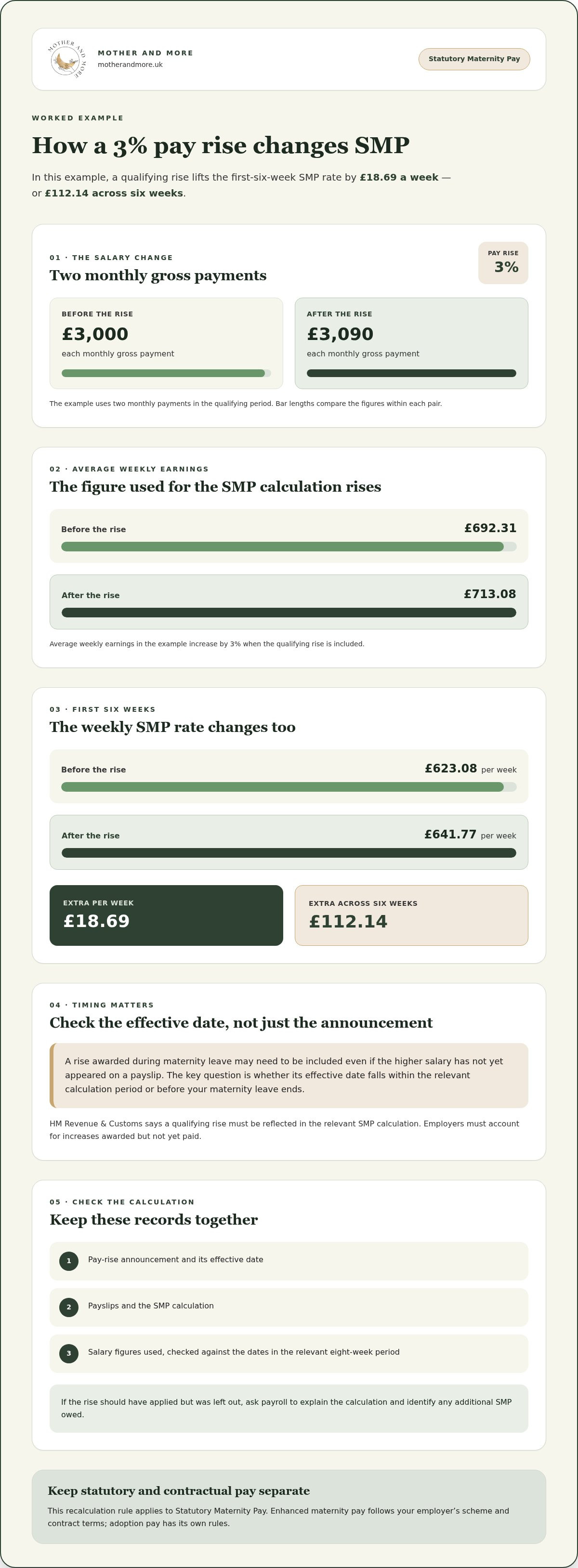
For example, imagine an employee’s qualifying period includes two monthly gross payments of £3,000. Their average weekly earnings in the example are £692.31. If a 3% pay rise is awarded and the two relevant monthly payments become £3,090 each, average weekly earnings rise to £713.08. The first-six-week SMP rate changes from £623.08 to £641.77 per week. That is a difference of £18.69 per week, or £112.14 across six weeks.
The effective date matters as much as the date an employer announces an increase. A rise due to begin in eight weeks may still need consideration if it is awarded during your leave and applies from the relevant period. Employers must account for increases awarded but not yet paid. In the example, the 3% rise increases average weekly earnings used for SMP by 3%. The higher figure can therefore change entitlement even before the new salary appears on a payslip.
To check whether your payment was recalculated correctly, gather the pay-rise announcement, its effective date, your payslips and the SMP calculation. Compare the salary figures used with the dates in the relevant eight-week period. If the increase should have applied but wasn’t included, ask payroll to explain the calculation and identify any additional SMP owed. Keep the response with your records.
This rule applies to statutory maternity pay; enhanced maternity pay follows your employer’s scheme and contract terms. Pay policies may also cover adoption, but adoption pay has its own rules, so don’t assume it follows the SMP calculation. Separating the statutory calculation from any contractual enhancement helps you identify which part of your payment may need correcting.
Rights on return from ordinary and additional maternity leave
Your return rights cover more than the date you resume work. They also matter when your role, terms or pay review changed during your absence. The Employment Rights Act 1996, section 47C and section 99, and the Maternity and Parental Leave etc Regulations 1999, regulations 19 and 20, provide employee rights related to pregnancy, childbirth or maternity leave.
Ordinary maternity leave and additional maternity leave are distinct parts of maternity leave. When you return, compare the role and terms offered with your employment contract and any written changes made before your leave. Note your return date, job title, responsibilities, hours and salary. If anything differs, ask your manager or HR to explain the change in writing and identify the relevant contract term or policy.
A pay review is one part of that comparison. Check whether your contract sets out a review process, then look for messages announcing salary decisions made during your absence. If colleagues in comparable roles received an increase, for example, ask whether the same criteria applied to you. Maternity leave itself shouldn’t be a reason to exclude you from a pay rise. Keep the response and any evidence of the decision.
While you’re on leave, you may miss updates about responsibilities, team structure or review dates. Ask for the current job description and the criteria used for salary decisions. Separate general business changes from a decision about your individual pay. That distinction helps you ask a focused question instead of relying on assumptions about why your salary stayed the same.
If a decision appears connected to pregnancy or maternity leave, set out the facts calmly. Include the decision date, the pay change, the colleagues or criteria used for comparison, and the effect on your earnings. Refer to section 18 of the Equality Act 2010, which makes it discrimination to treat a woman unfavourably because of pregnancy or maternity leave. Ask for the employer’s reasons and the process for raising a formal concern.
Keep a dated record of meetings, emails, payslips and contract documents. If you believe the treatment may lead to an employment tribunal claim, contact ACAS for Early Conciliation within three months less one day of the relevant act or series of acts. A clear timeline connects the decision, your maternity leave and any pay review, and gives you an organised basis for discussing the matter internally.
How do maternity pay and a pay rise interact in the UK?
A qualifying pay rise can change your Statutory Maternity Pay (SMP), even if your employer hasn’t backdated your salary. The key is whether the increase was awarded between the start of the relevant eight-week calculation period and the end of your maternity leave. If it qualifies, your employer must recalculate SMP using the higher earnings figure and pay any additional amount due.
SMP is calculated using your average weekly earnings over the relevant eight-week period before the qualifying week. If a pay rise takes effect during that period, or is awarded before maternity leave ends, it can affect the calculation. For SMP purposes, the rise is treated as effective from the start of the relevant period. This statutory calculation is separate from your contractual salary increase, which may have a different effective date.
For the first six weeks, SMP is paid at 90% of average weekly earnings. HM Revenue & Customs says employers must work out 90% of the employee’s average weekly earnings when calculating extra SMP due for a qualifying pay rise. HM Revenue & Customs also says employers must pay the difference in SMP for 6 weeks. This additional payment is due even when the salary rise itself isn’t backdated.
After the first six weeks, HM Revenue & Customs says SMP is paid for up to 33 weeks at the current SMP amount or 90% of average weekly earnings, whichever is lower. A revised earnings calculation may therefore change your first-six-week payment without changing later payments. The outcome depends on how the new average compares with the applicable SMP amount.
To understand the calculation, ask payroll for the original and revised average weekly earnings, the pay-rise effective date and the SMP rates used. Compare these with your payslips and the announcement confirming the increase. If the revised figures show that extra SMP is due, ask when the employer will make the top-up payment. Keep the calculation and response with your salary records.
If your employer hasn’t recalculated SMP, raise the issue in writing and explain which pay rise and dates you believe affect the calculation. HM Revenue & Customs can calculate additional SMP owed and order your employer to pay it. Provide the relevant earnings, pay-rise details and payment records so the calculation covers the correct period.
A pay rise can affect pension arrangements differently from SMP. During paid maternity leave, employer pension contributions continue for employees receiving SMP or occupational maternity pay, based on normal salary. The Alabaster ruling changes the SMP rate, but not pension contributions or salary sacrifice arrangements. Keep these questions separate when reviewing your payslip: a corrected SMP payment doesn’t itself change those arrangements.
How should I prepare evidence and market salary data for a pay rise request?
A strong salary request links your contribution to the pay level you’re seeking. Before meeting your manager, gather examples of your work, changes to your responsibilities and reliable salary information for comparable roles. This keeps the discussion focused on your value and the role, not your personal circumstances or the cost of having a baby.
Start with evidence of your impact. Choose specific projects, improvements or responsibilities you’ve taken on, then explain what changed as a result. If you took ownership of a client process, for example, describe the work you led and its outcome for your team. Use performance reviews, project records, emails and feedback to support each example. A short summary is easier to discuss than a folder of unrelated documents.
Next, compare your current role with salary information for similar work in London. Match responsibilities, sector, seniority and working pattern as closely as possible. A job title alone can mislead: two roles with the same title may involve different budgets, specialist knowledge or management duties. Note the source and date of each salary figure, and distinguish advertised ranges from salaries actually offered where that information is available.
Build a simple comparison showing how your position relates to the market. If a London advert gives a salary range for a role with similar duties, for instance, record which responsibilities match and which differ. Compare like with like, including whether figures refer to full-time work and whether benefits are part of the overall package. Don’t rely on a single advert; several relevant examples give you a more balanced picture.
Then connect your evidence to a clear request. State the salary level you’re seeking, explain how your responsibilities and results support it, and refer to your market comparisons. If your role changed during maternity leave, use the current job description and any written changes to show how its scope compares with your previous position. Keep your notes factual and take them to the meeting, so you can return to the evidence if nerves make the conversation difficult.
Prepare for questions about timing, budgets and review criteria. Ask how your employer assessed your role, what evidence would strengthen your case, and when the decision will be revisited if an increase isn’t agreed. After the meeting, email a brief summary of the discussion and any next steps. This gives you and your manager a clear reference for following up.
If you’d like space to explore confidence and identity alongside your return to work, find out about one-to-one life coaching.
Mother And More: Baby Massage Courses
Mother And More offers Baby Massage Courses and Baby Yoga Classes for parents and their infants in London. They provide a gentle way to share time with your baby as you settle into a new rhythm after leave.
If returning to work has raised questions about confidence, identity or wellbeing, One to One Life Coaching and Group Coaching offer space to explore those changes. Coaching can sit alongside practical steps at work, such as preparing your salary-review evidence, without replacing employment advice about your pay rights.
Choose the support that feels most helpful at this stage of your family’s journey. Contact Mother And More or visit motherandmore.uk to find out more.
Take your next step with confidence
Returning to work is a transition, not a test of how quickly you can feel like yourself again. Give yourself room to decide what matters most now: a clear conversation about your role, time to reconnect with your strengths, or a gentler rhythm with your baby. Thinking about how to ask for a pay rise after maternity leave can be part of that process, but your wellbeing deserves attention too.
If you’d like support alongside your work plans, Mother And More offers Baby Massage Courses, Baby Yoga Classes and One to One Life Coaching. Each offers a different way to nurture connection with your baby or make space for your own reflections as you move into this next chapter.
Contact Mother And More to explore the support that feels right for you. You can take this one step at a time, with confidence in what you bring to work and care for your family.
Frequently Asked Questions
Can I ask for a pay rise after maternity leave in the UK?
Yes, you can ask for a salary review after returning to work. If you’re considering how to ask for a pay rise after maternity leave, focus your request on your current responsibilities, contribution and relevant salary comparisons. Note any duties that have changed since your return, for example, and ask how your pay reflects them. You can also ask your manager which criteria will guide the decision and when you’ll receive a response.
What are my UK employment rights on pay and promotion after maternity leave?
Your pregnancy and maternity leave must not be the reason you’re treated unfavourably in decisions about pay or promotion. Section 18 of the Equality Act 2010 covers this protection. It doesn’t mean a promotion or increase is automatic: employers can assess candidates against relevant criteria. Ask for the promotion requirements, review records and reasons for a pay decision. These details can help you understand whether the same standards were applied to you.
Can my employer exclude me from a pay review while I am on maternity leave?
Your employer shouldn’t exclude you from a pay review simply because you’re on maternity leave. Ask whether the review took place, which criteria it used and how your performance or role was assessed during your absence. If the review relied on a meeting you couldn’t attend, for example, ask whether you can provide relevant evidence another way. Keep the response and review documents with your employment records.
Could being denied a pay rise after maternity leave be maternity discrimination?
It could be maternity discrimination if you were denied a rise because of pregnancy or maternity leave. A refusal alone doesn’t show why the employer made its decision, so focus on evidence: compare the stated criteria with how they were applied, and note relevant comments, dates and decisions. Section 18 of the Equality Act 2010 prohibits unfavourable treatment because of pregnancy or maternity leave. You can raise your concern through your employer’s process.



Comments