

How to Manage a Team After Maternity Leave: A Practical Guide
Updated: 2 days ago
What if returning to leadership doesn’t mean picking up exactly where you left off? If you’re wondering how to manage a team after maternity leave, you may be facing more than a full inbox: priorities may have shifted, team relationships may feel different, or you may be working out how to balance your role with new caring responsibilities. You don’t have to pretend nothing has changed or prove your commitment by doing everything at once.
It’s understandable to want to reconnect quickly and feel confident in your role again. A steadier return starts with clarity, care and shared expectations. With a thoughtful plan, you can listen, reset priorities and lead in a way that respects both your professional strengths and the realities of family life.
This guide offers practical ways to shape your first weeks back, talk with your team and senior colleagues, and set clear expectations around workload and availability. You’ll also find ways to rebuild confidence and establish a sustainable leadership rhythm, without expecting yourself to be exactly the same person you were before leave.
Table of Contents
Returning to Lead: What Changes When You Manage a Team After Maternity Leave?
You might feel excited to see your colleagues again, then uncertain about whether you still know how things work. Guilt, a dip in confidence or a sense of being out of step can sit alongside genuine enthusiasm. These feelings don’t mean you’re less capable of leading. You’re returning to a role that may have changed while your own life has changed, too.
Think of this as a transition for both you and the team, not an exam in whether you can immediately perform at your pre-leave pace. Team members may have taken on new responsibilities, reporting lines may have shifted, or decisions may now be made differently. Even informal routines, such as who shares updates or resolves a problem first, can evolve. A broad overview of Parental Leave Policies offers context for how leave is understood across different settings. Your first task, though, is to understand what has happened in your own team.
A successful return means clear priorities, renewed connection and expectations that are sustainable for you and your team. That’s a more useful measure of progress than trying to recreate every detail of your old routine.
What may have changed while you were away?
Begin with facts, not conclusions. A project deadline may have moved, a colleague may now own a task you previously managed, or your team may have developed a new way to make day-to-day decisions. These are practical changes to understand. They don’t automatically mean your standing has weakened or that something needs fixing.
Set aside time to ask what’s working, what feels unclear and where responsibilities now sit. You might learn that regular written updates help the team stay aligned, or that people aren’t sure which decisions need your input. Listen before proposing changes. Colleagues have also adapted to a different reporting rhythm, so reconnecting may take a little time on both sides.
Why returning to your old pace isn’t the only measure of success
It can be tempting to accept every responsibility straight away, especially if you’re worried that colleagues might question your commitment. But credibility doesn’t depend on being available at every moment or immediately taking back every task. Clear boundaries give people practical information: when you’re available, what needs your attention and how the team can keep work moving.
Try making one small leadership move at a time. Clarify who owns an urgent decision. Thank someone for keeping a project on track. Agree a regular check-in with a direct report. These visible actions can rebuild familiarity and confidence without requiring you to feel completely settled first. As you learn what has changed, decide what to continue, adjust or revisit. That’s a grounded way to manage a team after maternity leave: lead from the current reality rather than measuring yourself against an old routine.
Rebuild Trust and Team Clarity After Maternity Leave
Trust doesn’t need a grand gesture. It grows when people feel heard, understand who is doing what and can rely on agreed ways of working. Before changing a process, take time to see how the team operates now. You may discover that a colleague has developed a strength worth building on, or that an informal workaround is causing confusion. Listening first helps you respond to the team in front of you, rather than the one you remember.
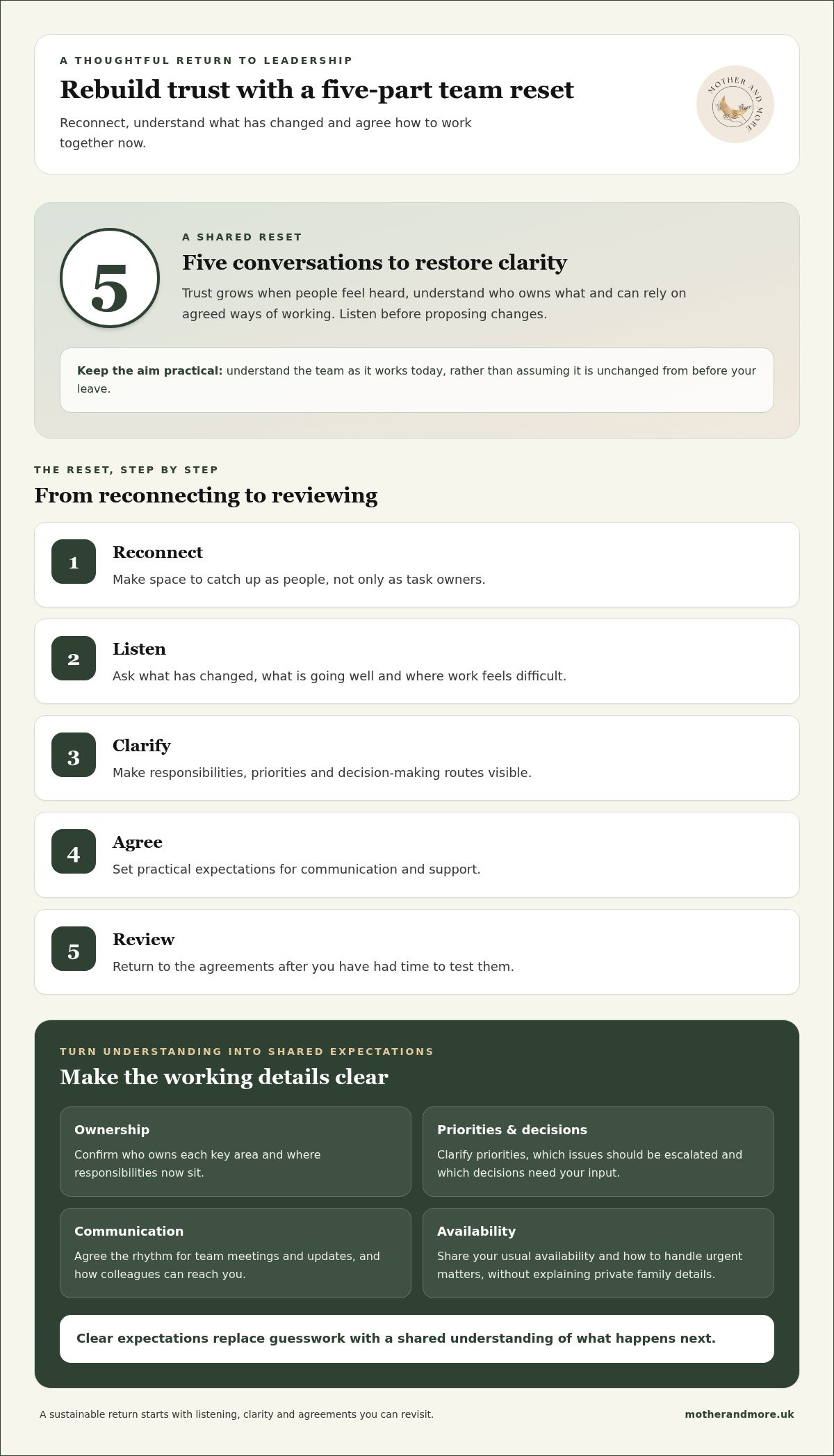
A simple reset can guide your conversations and give everyone a shared sense of direction:
Reconnect: Make space to catch up as people, not only as task owners.
Listen: Ask what has changed, what is going well and where work feels difficult.
Clarify: Make responsibilities, priorities and decision-making routes visible.
Agree: Set practical expectations for communication and support.
Review: Return to the agreements after you’ve had time to test them.
Clear expectations replace guesswork with a shared understanding of what happens next. Share relevant information about your working arrangements, such as your usual availability or how to handle urgent matters, without explaining private family details. You can choose what you do and don’t share.
Plan a listening-first return conversation
Use one-to-ones to understand each person’s current priorities, workload, team changes and support needs. Open questions invite a fuller picture: “What has shifted most while I was away?” or “Where would clearer ownership help?” Leave room for colleagues to raise what matters to them, even if it isn’t what you expected to hear.
You don’t have to solve everything in the meeting. Reflect back the main themes, note questions that need follow-up and agree when you’ll revisit them. This shows you’re taking concerns seriously without promising an immediate fix before you understand the context.
Reset responsibilities, communication and decision-making
Once you’ve listened, make the working details explicit. Confirm who owns each key area, which issues should be escalated and which decisions need your input. Agree the rhythm for team meetings and updates, including how colleagues can reach you and when they can expect a response. If a decision can wait until your next check-in, say so. If it needs a quicker route, make that clear too.
These practical conversations may sit alongside questions about confidence or how your identity has shifted since becoming a mother. Reading about life coaching for mums and identity after motherhood may help you consider what you want from this transition. Mother And More offers one-to-one life coaching for mothers, with space to reflect on confidence, values and next steps as you return to leadership.
If you need to clarify a workplace policy or an agreed working arrangement, raise the specific question with your manager or HR contact. Keeping the conversation focused on your role, responsibilities and team’s needs can help you agree practical expectations for your UK workplace.
Do You Need to Prove You Can Do It All? Rethink the Return
Returning to work can bring quiet pressure to show that nothing has changed. You might take on extra tasks, reply outside your usual hours or avoid asking for support because you’re concerned it could be read as a lack of commitment. These responses are understandable, but they can set expectations that become difficult for you and your team to sustain.
There’s no single return-to-work experience. Your needs may depend on your caring arrangements, health, role and what helps you feel confident. Workplace conditions, including staffing levels and available flexibility, also shape what’s realistic. Effective leadership doesn’t require recreating your pre-leave availability. It means making priorities clear, following through on what you’ve agreed and helping the team understand how work will move forward.
Constant availability can feel reassuring in the moment, but it isn’t the only way to build trust. A clear update on a priority, a decision made when promised or an agreed handover can give colleagues more certainty than a quick reply at any hour. Taking on more work may bring short-term momentum, but it can also use up capacity. Neither response deserves judgement. Ask which approach serves the team without quietly draining you.
Recognise overcompensation before it becomes your new routine
Notice whether you’re accepting work before checking your existing commitments, avoiding reasonable requests for support or feeling you must stay reachable throughout the day. Before saying yes, pause and ask: what team priority does this serve, and what will need to move if I take it on?
You could say, “I can take this on if we move the report to next week. Which is more important?” This keeps the conversation focused on priorities rather than proving your capacity. A short pause gives you room to consider the trade-offs instead of committing from guilt or habit.
Set boundaries without stepping away from leadership
Boundaries work best when they come with a dependable plan. Explain your availability, how colleagues can reach you and what should happen if a genuinely urgent decision can’t wait. For example: “I’m available for planned discussions during these hours. If a decision can’t wait, please contact the agreed deputy, who can escalate it if needed.” Keep any arrangements aligned with your workplace’s policies and discussions with your employer.
Delegating doesn’t mean abandoning responsibility. Agree the outcome and decision-making limits, then ask a colleague to manage the day-to-day steps. Set a time to review progress and stay accountable for decisions that remain yours. This gives people room to act while keeping support and oversight clear.
As you work out how to manage a team after maternity leave, look for evidence of steady leadership rather than a perfect return: priorities are understood, responsibilities are realistic and commitments are kept. If those conditions are difficult to create, that may point to a workplace issue to discuss, not a personal failure to try harder.
How to Manage a Team After Maternity Leave: A First-Weeks Action Plan
A clear plan can make your return more manageable without asking you to predict exactly how you’ll feel or what the team will need. Treat these steps as a flexible starting point, adapting them to your role, team size and workplace arrangements. The aim isn’t to stick to a fixed timetable. It’s to create regular opportunities to check what’s working and adjust.
Prepare before your first day back. If it’s helpful, request a focused update from your manager or the colleague who has been covering your role. Ask about team changes, decisions made, upcoming deadlines and immediate risks. Focus on what you need to lead, rather than trying to absorb every detail from your time away.
Agree a practical return-to-work plan. Speak with the appropriate workplace contact, such as your manager or HR contact, about initial workload, priorities, communication and any agreed working arrangements. Useful questions include: What needs my attention first? Which responsibilities can remain with others for now? How will urgent matters reach me? When can we review this plan? Write down questions that need answers straight away and keep other topics for a later conversation.
Set a starting rhythm, not a rigid promise. Agree how you’ll receive updates, when you’ll meet with your team and how your manager will check in with you. Informal conversations may be enough for a smaller team; a larger team may need a clearer pattern of updates. Leave room to change the rhythm as you learn what the work and your caring arrangements require.
Use early conversations to understand before changing. Meet colleagues individually where practical and ask what’s running smoothly, what’s difficult and where they need clarity. Compare what you hear with the handover and note anything that needs a closer look. Avoid making significant process changes before you understand why a routine was introduced or what the team relies on it for.
Choose priorities and review them together. Identify a small number of outcomes that matter most, then be explicit about what can wait. For example, if a deadline takes priority, tell the team which lower-priority task will be delayed or reassigned. Schedule a review with your manager to discuss workload, confidence and support, then adjust responsibilities or communication where needed.
There’s no universal point at which everyone should feel settled. Your needs, responsibilities and workplace conditions are individual, so let regular check-ins guide the pace. A useful question at each review is: “What should we keep, change or clarify before the next one?” That keeps the plan responsive instead of turning it into another standard you have to meet.
If you’re reflecting on confidence and next steps alongside the practical plan, one-to-one life coaching for mothers can provide a space to consider your career transition.
Build a Sustainable Leadership Rhythm and Find Support That Fits
You don’t have to work out your return to leadership entirely on your own. The most useful support depends on what feels difficult: a workload or workplace arrangement may call for a conversation with your manager or HR contact, while questions about confidence, identity or career direction may need space for reflection. Trusted colleagues and peer communities can offer understanding from people with shared experience, but they aren’t a substitute for formal workplace advice when that’s what you need.
Choose support around the need you’re carrying
If your responsibilities feel unmanageable or you need clarity about a workplace policy, take the practical question to the appropriate person at work and consult current UK guidance where relevant. A peer may help you feel less alone, but they can’t determine how your organisation’s arrangements apply to you. Keeping these kinds of support distinct can help you get a more useful response.
Coaching may be helpful if you’re trying to untangle questions such as: What does confident leadership look like for me now? Which boundaries matter most? Do my current responsibilities still fit the direction I want my career to take? These questions can feel particularly tender when your identity has shifted alongside your role as a manager. One-to-one coaching offers a supportive space to explore your values, confidence and possible next steps. Platforms such as Ascendly, which combine flexible online learning with personalised one-to-one career coaching, can provide practical support as you navigate this transition. It doesn’t promise a particular outcome; it gives you room to think with care and intention.
Create a leadership rhythm that can evolve
Rather than aiming for a perfect plan, set regular moments to check how your working rhythm feels in practice. Review priorities and workload with your manager, notice whether your boundaries are being respected and consider whether the team has the clarity it needs. If an arrangement is creating friction, use what you’ve learned to adjust it or raise the issue with the right workplace contact.
Progress can be quiet but meaningful. Perhaps you’re delegating a decision that used to sit with you, having a more open conversation about capacity or finishing the week with a clearer sense of what matters next. These are signs of leadership taking shape in your current circumstances, not proof that every challenge has disappeared. How to manage a team after maternity leave can remain an evolving question as your needs and the team’s needs change.
Mother And More supports mothers through life coaching focused on confidence, wellbeing and career transitions. The East London based business also works with mothers across the UK. Explore Mother And More’s coaching for mothers navigating career transitions as a space to reflect on what comes next, at a pace that feels right for you.
Let Your Next Chapter Take Shape
You don’t need to have every part of your working life figured out before you can lead well. This return can be a chance to notice what matters to you now and shape a way of working that feels purposeful and sustainable. You’re allowed to grow into it, one considered decision at a time.
If you’re still asking how to manage a team after maternity leave, consider what would help you feel more grounded in your next step. That might be a clearer conversation at work, a trusted person to talk things through with, or dedicated space to reflect on confidence, identity and career direction.
Mother And More offers one-to-one and group coaching for mothers exploring these transitions. Founded by Rebecca Beazley, an accredited life coach and former social worker, the business has supported hundreds of mothers across the UK. Coaching offers room to reflect without promising a particular outcome. If you’d value support as you consider your next career chapter, explore coaching with Mother And More.
Frequently Asked Questions
Can my team contact me while I am on maternity leave?
Some contact may be appropriate, but you’re not expected to carry out your normal role throughout maternity leave. Before leave, agree with your employer who may contact you, about what and how often, so you can stay informed without feeling on call. If you choose to do work during leave, ask about the arrangements for keeping-in-touch days and pay. You can revisit contact boundaries if circumstances change.
What should I ask my manager before returning from maternity leave?
Ask for the information you need to make decisions, rather than a full replay of everything that happened. For example: “What are the most time-sensitive priorities?”, “Have reporting lines or decision-making routes changed?” and “Which responsibilities are still being covered by someone else?” If you’re planning how to manage a team after maternity leave, also ask what flexibility is available and when you can review your initial workload together.
How do I handle a team member who took on my responsibilities while I was away?
Start by recognising the work they’ve carried and asking what they’ve learned about the role or team. Then agree a clear handover: which tasks return to you, which they’ll continue to own and where their contribution could develop. Avoid assuming that every temporary arrangement should end immediately. If responsibilities are unclear, discuss them with your manager so the colleague isn’t left with conflicting expectations or an abrupt loss of ownership.
What if my confidence has changed since becoming a mother?
A change in confidence doesn’t mean your leadership ability has disappeared. Note specific moments that show your judgement at work, such as resolving a decision or helping a colleague move forward. Ask someone you trust for concrete feedback rather than relying on a general sense of how you’re doing. If questions about identity or career direction are difficult to untangle alone, coaching can provide space to reflect and consider your next steps; organisations such as Intact Academy highlight how executive and team coaching can support leaders through periods of significant professional change.
Can I request flexible working when I return to work in the UK?
Yes. In the UK, employees have a day-one right to request flexible working, though that doesn’t mean every request must be accepted. GOV.UK explains the process and what to include in a request. If you’re working in London or elsewhere in the UK, check your employer’s procedure and explain how the arrangement could work for your role, including team cover, meetings and responsibilities. Discuss practical options with your manager.
How can I respond if colleagues assume I am less committed after maternity leave?
Respond calmly by making your priorities and contributions visible. You could say, “I’m committed to leading this work, and I’d like us to agree the best way to cover these meetings around my working pattern.” Keep a record of agreed objectives and decisions so conversations can focus on outcomes rather than assumptions. If comments continue or affect how you’re treated at work, raise specific examples with your manager or HR contact.
How long does it take to feel settled managing a team again?
There’s no set timetable. The pace can depend on what changed during your leave, how your responsibilities are arranged and what support is available. Rather than waiting to feel completely settled, look for practical signs: you know where to get key information, your team understands how to work with you, and your workload can be discussed openly. If those things aren’t improving, use a check-in with your manager to identify what needs to change.



Comments